
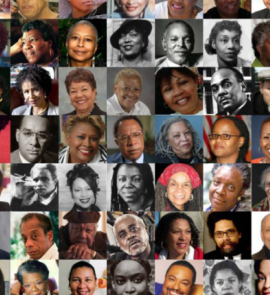
Located at the Rudisill Regional Library, the purpose of the African American Resource Center is to collect, preserve and provide access to resources honoring and documenting the experiences of people of African descent. The center is devoted to providing the community with current and comprehensive resource materials and professional reference materials on the culture and history of African Americans.


Email: larissa.mcneil@tulsalibrary.org
Phone: 918.549.7650
Click on the boxes below to view some of the AARC's previous events.
Upcoming events will be posted here too. Check back to catch the next one!

Events
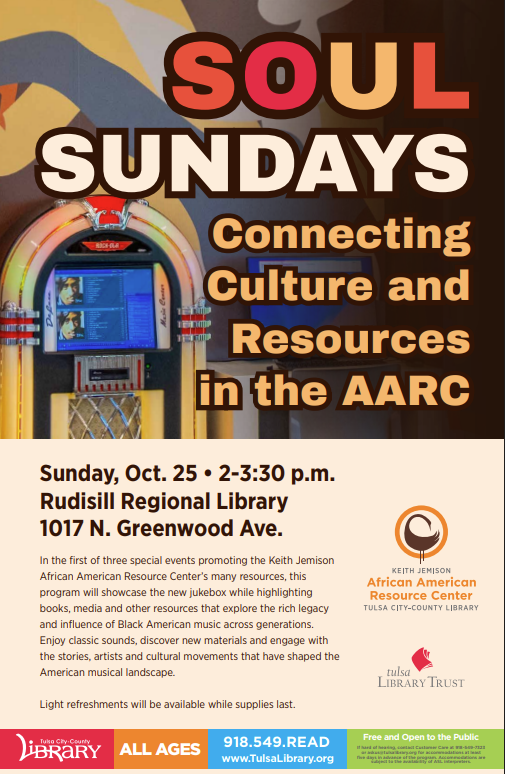
Soul Sundays - Connecting Culture and Resource in the AARC (Part 1)
Come explore the new jukebox and the impact of Black American music! Learn more about the collection and the resources we offer!
October 2026

Research Your Family History
African-American Heritage Database
This deep web resource is exclusively devoted to African American family history research. (Note: This database may only be accessed on site at the Rudisill Regional Library)
It provides users a dedicated resource that not only brings together records critical to African American family research; but also connects them to a community of research experts, whose mentoring and assistance can frequently lead to research success.
Search essential historical records for African-Americans, including Federal Census, Marriage and Cohabitation Records, Military Draft and Service Records. Registers of Slaves and Free(d) Persons of Color, Freedman’s Bank and more.
Available only for TCCL library card-holders at the Rudisill Regional Library - 1520 N.Hartford, Tulsa, Oklahoma (918)549-7645
Oklahoma's All-Black Towns
Information on All-Black Towns
All-Black Towns Still in Existence
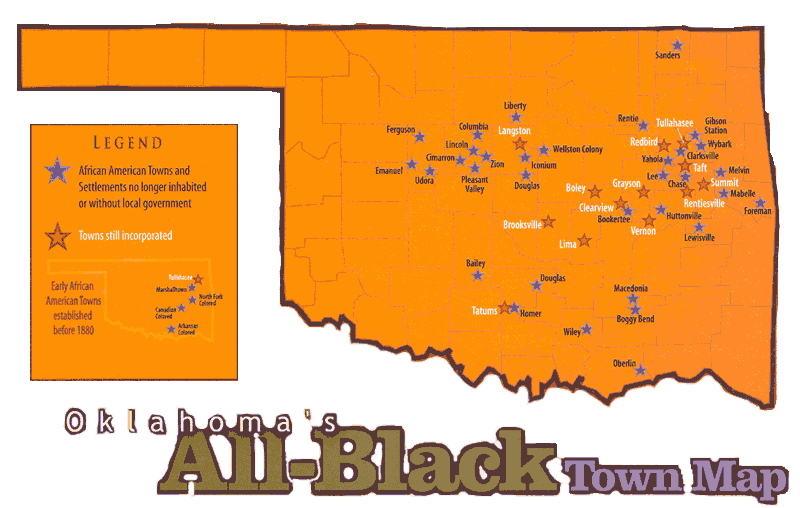
The links above provide more information about the history and culture of all-black town in Oklahoma.
The first all-black town was incorporated around 1865 after the Civil War when formerly enslaved people settled in Indian Territory. As the towns grew, many African-Americans, particularly in southern states, migrated to Oklahoma with the hope that they would get to experience the same prosperity that was becoming more of a norm for African Americans in Oklahoma. By 1920, there were more than 50 towns
Today, there are still 13 all-black towns in existence, some with as many as 1,000 residents. Click on the above links to learn more.
African-Americans in Oklahoma
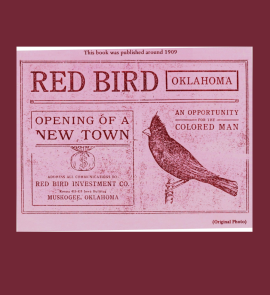
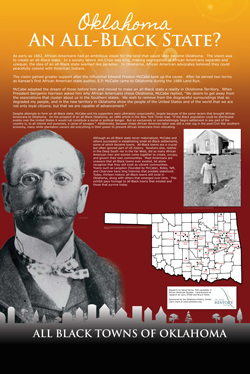
The above article details the existence of African-Americans in Oklahoma before and after Oklahoma became a state. Initially thought of as the "Promised Land," many Black people were interested in moving to Oklahoma because the avenues for prosperity extended to African-Americans as well. The image below provides a quick snapshot but the article gives a more in-depth account of life during that time.
Significant Eras in African-American History
The following links from the Black Past website lead to a search page where you can find various articles about the topics.
While African-American history cannot be summed up in these few eras, these provide a great starting place to learn more about the history of Americans of African descent. Each search page has information about the eras in general as well as various articles about significant incidents regarding these topics.
Abolitionism
The Underground Railroad
African-American During the Civil War
African-Americans During Reconstruction
The Harlem Renaissance
The Great Migration
The Civil Rights Movement
The Black Arts Movement
The Black Lives Matter Movement
Greenwood, Tulsa
We Lived Like We Were on Wall Street
A Walk Along Black Wall Street
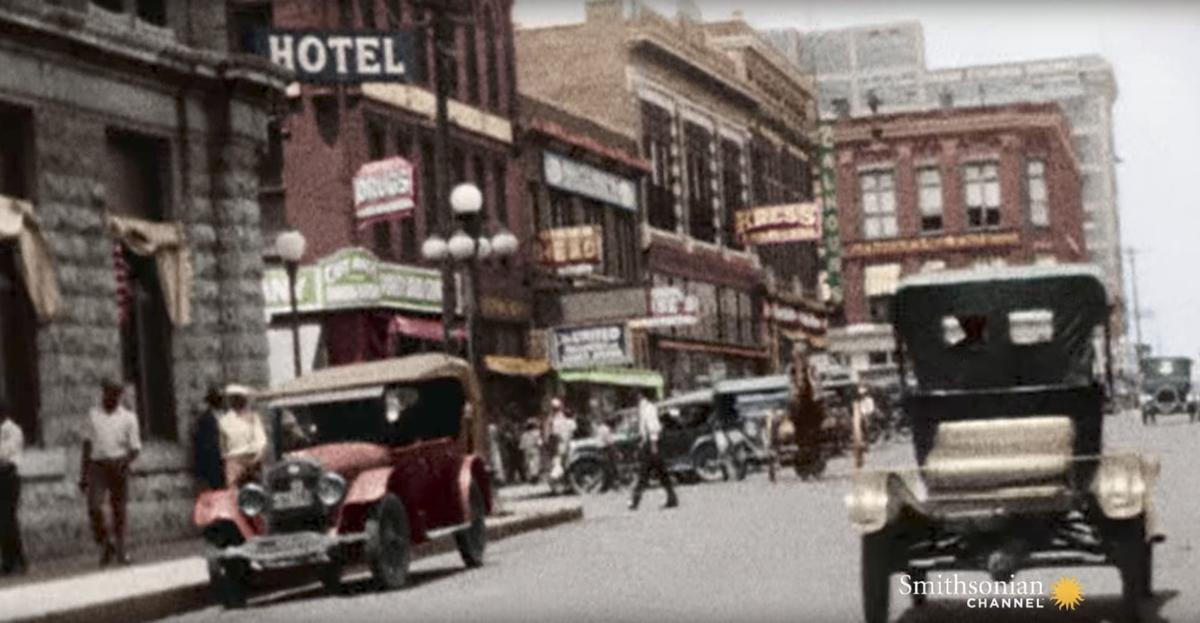
Colorized Photo of Greenwood Tulsa from Smithsonian
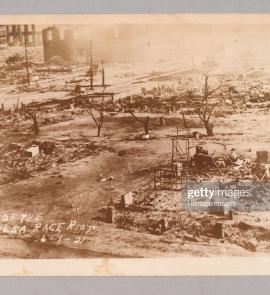
Too often, the history of Tulsa is spoken about in terms of the destruction caused during the 1921 Race Massacre, formerly known as the 1921 Tulsa Race Riot. However, the Greenwood district of Tulsa was a place teeming with places of both business and leisure for African-Americans. There was a strong culture in the area, and residents felt that they had found a place where they could be wholly themselves.
The articles above provide accounts about what life was actually like for the residents of Greenwood. There are statements from survivors of the massacre as well as images that give glimpses of lives that many didn't think was possible for African-Americans.
Booker T. Washington High School
Booker T. Washington: A History
Once Oklahoma became a state, many of the holds of segregation were pushed onto the residents. That included segregation in schools. In 1908, a two-room school was constructed in the Greenwood neighborhood of Tulsa and was named Dunbar Grade School serving students from 1st to 8th grade. In 1913, a second building was added to serve as the high school and would become Booker T. Washington High School.
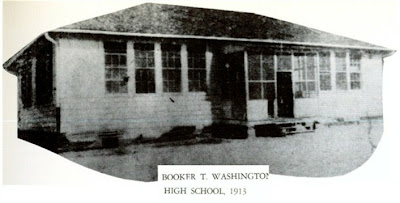
The above blog post combines information from several sources, including the Tulsa Preservation Committee, to explain the long history of Booker T. Washington High School, from it's inception in 1913 to its desegregation in 1973 and beyond. Images of the school over the years are also included.
Podcast on African-Americans in Oklahoma
NPR's Focus: Black Oklahoma Podcast
This recent podcast focuses on how issues that pertain to the greater African-American community are being handled in various parts of Oklahoma. While the topics are not necessarily focused on history (for example, there are episodes that focus on the effect of the COVID-19 virus in the community), they do discuss issues which have stemmed from historical practices.
Reference Materials
- Reference Books
- Dictionaries
- Encyclopedias
- Bibliographies
- Newspapers/Periodicals
- Indexes
- Dawes Rolls
Jukebox Listening Station
An homage to the musical artistry of African-Americans. Hear the soulful sounds of great African-American composers, singers and musicians on our brand-new Rockola jukebox.
Viewing Stations
- North Tulsa oral histories (DVDs)
- African-American history (videos and DVDs)
Materials for Teachers
To be updated.
Electronic Reference Sources
- Inventors and Innovations
- Encyclopedia of African-American History and Culture
- American Social Leaders
- Heritage Facts Online
- Multicultural America
- African-American Heritage Genealogy Database (can only be accessed at Rudisill Regional Library)
Public Programs
- Author appearances and book signings
- Book discussions
- Annual tour of Oklahoma’s historic all-black towns
- Annual Kwanzaa celebration
- Annual Black History Month celebration
- Grapevine Literary Society Book Club (Join us!)
Books about Black and African American Culture
Look through these lists of books on various topics that focus on the experiences of Black and African American people. These lists are not comprehensive and recommendations are welcome!
Books on Oklahoma's Black Towns
Poetry by Black and African American Authors
Contemporary Fiction Books by Black Women Authors
2022 Sankofa Freedom Award Winner: Books by Walter Mosley
Books featuring Black and African American Families
Food is Culture: Cookbooks with Recipes from across the African Diaspora
2024 Sankofa Freedom Award Winner: Books by Terry McMillan
What is GTAAAC?
The Greater Tulsa Area African American Affairs Commission (GTAAAC) is a group of mayoral appointed volunteers established by City Ordinance in 2017. The Commission is comprised of 23 representatives from the African American community. The Commission primarily serves in an advisory capacity to the Mayor and City Council by conducting research and recommending policies, programs, and initiatives to aid their community.
The Greater Tulsa Area African American Affairs Commission is one of six Title V Commissions staffed by the Department of Resilience and Equity. It heavily contributes to City of Tulsa’s Resilience Strategy pillar to build an inclusive future that honors all Tulsans and celebrates our diversity. The Resilience Plan serves as a roadmap to address Tulsa’s most pressing challenges and seeks to build capacity among residents, city systems, and community partners to build a more resilient, equitable, and world class city.
The Commission is made up of twenty-three members of African American descent appointed by the mayor. Twelve members serve as representatives for organizations whose primary mission is to advance or provide services to African American culture and heritage. Eleven members serve at large.
In addition, the Commission has three standing committees, which include:
- Policy Recommendation
- Community Engagement and Culture Promotion
- Education and Skill Building
2026 Newsletters
Online Databases Accessible Through TCCL
Black History Saturdays
"Black Oklahomans past and present hold a pivotal position in understanding the black experience in America. Just over 100 years since the destruction of Greenwood in Tulsa, OK and in the midst of concerted efforts to mute the teaching of history (through policy like HB 1775) its critical to uncover the untold history of the Black experience in Oklahoma. Launching in Tulsa, Black History Saturdays is a community education program created for the purpose of educating young people, their families, and the wider community toward a more honest and comprehensive understanding of Black history in Oklahoma and across the globe. The goal is to increase public knowledge, promote youth engagement, and equip the next generation of change-makers with historical and cultural knowledge that will inspire them to create powerful impact within their communities." -Copied from the website
Resource Guide: Supporting BIPOC Students in College and Trade School
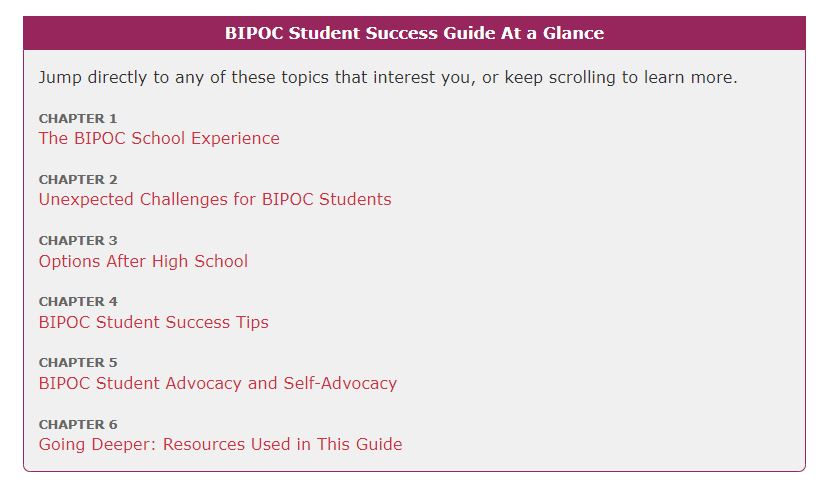
Supporting BIPOC Students in College and Trade School
A guide created by the editor of Beauty Schools directory to support BIPOC students as they navigate post=secpmdary school options.
TRIO - Educational Opportunity Centers


What is the Right to Read?
The Right to Read is a documentary about the growing problem of illiteracy in the United States. In Tulsa County, only 26% of third graders can read proficiently - a problem that exacerbates as students get older.
This screening documents some of the work whole states and other individuals are doing in order to increase literacy and reading enjoyment. It was great to learn more about this issue and pledge to support the right to read for students across Tulsa. You can help too.

Documentary
Watch the documentary here.
Teach for America Literacy Support Efforts
Learn more about what Teach for America is doing to support literacy efforts here.
Resources for Educators and Community Members
Read through this list of resources here to see how you can help!
BeHeard Movement
According to their website:
BeHeard is Oklahoma's only mobile drop-in center, providing showers, laundry, haircuts, and case management all on wheels.
Our newest innovation, Virtual Volunteer Vending Machines, allows neighbors to access essential services whenever they need them while giving volunteers the opportunity to make an impact from anywhere.
Through innovation and community, our goal is to impact real people while working to end homelessness one neighbor, one conversation, and one shower at a time.
Dream Center
According to their website:
Located in the heart of an area ravaged by poverty, lack of resources, and income disparity, the Tulsa Dream Center focuses on addressing the area’s critical needs through programs designed to produce outcome-based results. The Department of Housing and Urban Development (HUD) has designated it an EnVision Center due to its vital programs which address the four critical areas of life: economic empowerment, educational advancement, health and wellness, and character and leadership.
Founded in 1999 by Pastor Billy Joe Daugherty of Victory Christian Center, the Tulsa Dream Center opened to bring hope and healing to the North Tulsa community. While TDC has grown and our programs are much more expansive than 20 years ago, the heart behind what we do and how we serve remains the same. We are committed to bringing well-rounded solutions that lead to the empowerment of each individual that we touch in order to build a brighter future for our community.
Through strategic programs and partnerships, the Tulsa Dream Center has created diverse solutions to bring this diverse city together and expand the horizon of the North Tulsa community for lasting change.
This focus on providing educational opportunities, spurring economic growth, and expanding social service programs to break the cycle of poverty in North Tulsa is why the Tulsa Dream Center has been designated as an EnVision Center, one of only three in the state. Through HUD’s EnVision Center Initiative, the Tulsa Dream Center is providing a centralized hub for economic empowerment, educational advancement, health and wellness, and character and leadership so that the citizens in North Tulsa can build a stronger, healthier tomorrow.
Click here to learn more about the services provided by the Tulsa Dream Center.
Met Cares Foundation
According to their website:
Met Cares Foundation’s mission is to transform the academic and social outcomes of North Tulsa children while building power in North Tulsa families.
Met Cares is committed to empowering North Tulsa residents to lead change within their own community. Our signature programs are designed to do this by boosting school attendance, strengthening parent leadership, and creating workforce pathways for North Tulsa families.
Due North
According to their website:
Due North was created in response to the overwhelming number of underserved residents in Tulsa’s Districts 1 & 3. The purpose of the program is to provide North Tulsa residents the opportunity to receive the soft skills and other training necessary to be successful. The program relies on the relationships built between the residents, community partners and local businesses. Due North grows and strengthens relationships to build a stronger community.
For North Tulsa Residents: We connect North Tulsans with exceptional, local employers by providing access to high-quality short-term training, certifications and career support at no cost to our customers. The training offered is designed to help North Tulsa residents gain meaningful employment that provides increased wages and benefits which in turn strengthens families.
For North Tulsa Businesses: North Tulsa is home to some of Tulsa’s most reputable and stable businesses. From McElroy to Muncie to Greenheck and more, Districts 1 and 3 are full of employers that need skilled workers. Due North helps North Tulsans earn the knowledge and certifications at no cost to become the skilled workforce for these organizations.
Click here to find out how Due North is helping North Tulsa.
John 3:16 Mission
According to their website:
John 3:16 Mission is a interdenominational Christian ministry that endeavors to be the "hands and feet of Christ" to the homeless, hungry, poor and at-risk of the Tulsa community.
This means meeting their physical, emotional, mental and spiritual needs.
John 3:16 Mission is not affiliated with any church or denomination. As a nonprofit, 501 (c) (3), the Mission is funded solely by donations from supporters (individuals, companies, foundations, churches, etc.) throughout the Tulsa community and beyond who desire to make relief and recovery programs available.
The Mission adheres to the highest standards of quality of care, treating each person or client, regardless of race, gender, creed or faith background, with dignity and respect.
Founded in 1952, John 3:16 Mission has served the homeless of the Tulsa community for nearly 70 years. The Mission has always been dedicated to the proposition that the homeless are entitled to compassionate, dignified care and no one in need is turned away, whatever their background.
Since its founding, John 3:16 Mission has served millions of meals and provided millions of nights of lodging to our community's most vulnerable and troubled people. Beyond providing meals and safe shelter, the Mission endeavors to lead the hurting and the lost into a life transforming relationship with Christ.
Click here to learn more about what they do for the community.
Northside Neighbors
According to their website:
Northside Neighbors is transforming north Tulsa through community-led efforts in education, housing, wellness and economic vitality. This nonprofit is bringing together residents and partners to foster prosperity and thriving neighborhoods.
Strengthening north Tulsa
In 2024, InvestNorth launched Northside Neighbors, a resident engagement initiative with the goal of understanding the opportunities and challenges surrounding north Tulsa neighborhoods from the resident’s perspective.
Starting in the Hawthorne and Whitman neighborhoods, Northside Neighbors has engaged more than 500 residents on education, housing, wellness and economic vitality. Now a fully realized nonprofit, the resident-focused organization is dedicated to creating thriving neighborhoods in partnership with residents and neighbors.
Click here to learn more about the work of Northside Neighbors and other affiliated programs.
Oasis Fresh Market
According to their website:
In what the USDA classifies as a ‘food desert,’ in the heart of North Tulsa, now springs up Oasis Fresh Market. Our store’s mission is to reduce barriers for community residents of North Tulsa to access fresh fruits and vegetables, but our heart reaches so much further than just a grocery store.
We are also tangentially launching a non-profit organization, The Oasis Projects, whose mission is to develop programs to reduce barriers and build bridges for other community needs, whatever those maybe!
Store Hours
Monday – Saturday | 8am-10pm
Sunday | 8am-8pm
Visit Black Wall Street Memorial Sites
The 1921 Tulsa Race Massacre is considered one of the deadliest race massacres in American history. There are a number of sites, including a brand new museum, dedicated to understanding the roots of what happened during the massacre and memorializing the lives lost and otherwise affected. These memorial sites are a must see for visitors and Tulsa-natives alike.
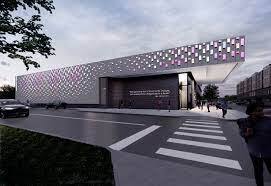
Visit Greenwood
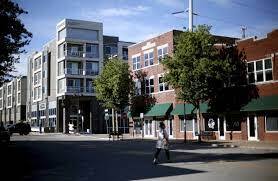
Note that this is not a comprehensive list of all of the businesses in the Greenwood neighborhood of Tulsa. These links lead to the business websites so that you can check out the amazing services and goods they provide.
Historic All-Black Town Tour
Every June, the AARC takes a number of community members on a tour of a couple of Oklahoma's all-black towns. The event is an all day affair and includes a light breakfast, a bus tour through the towns with historians providing real-time information about them, and lunch in one of the towns.
As June nears, the AARC will send out information about how to sign up. Please note that there is a cost and a limited number of seats.
To learn more about the tours or to be notified by email of tour information, please email Larissa McNeil (contact info provided to the left).